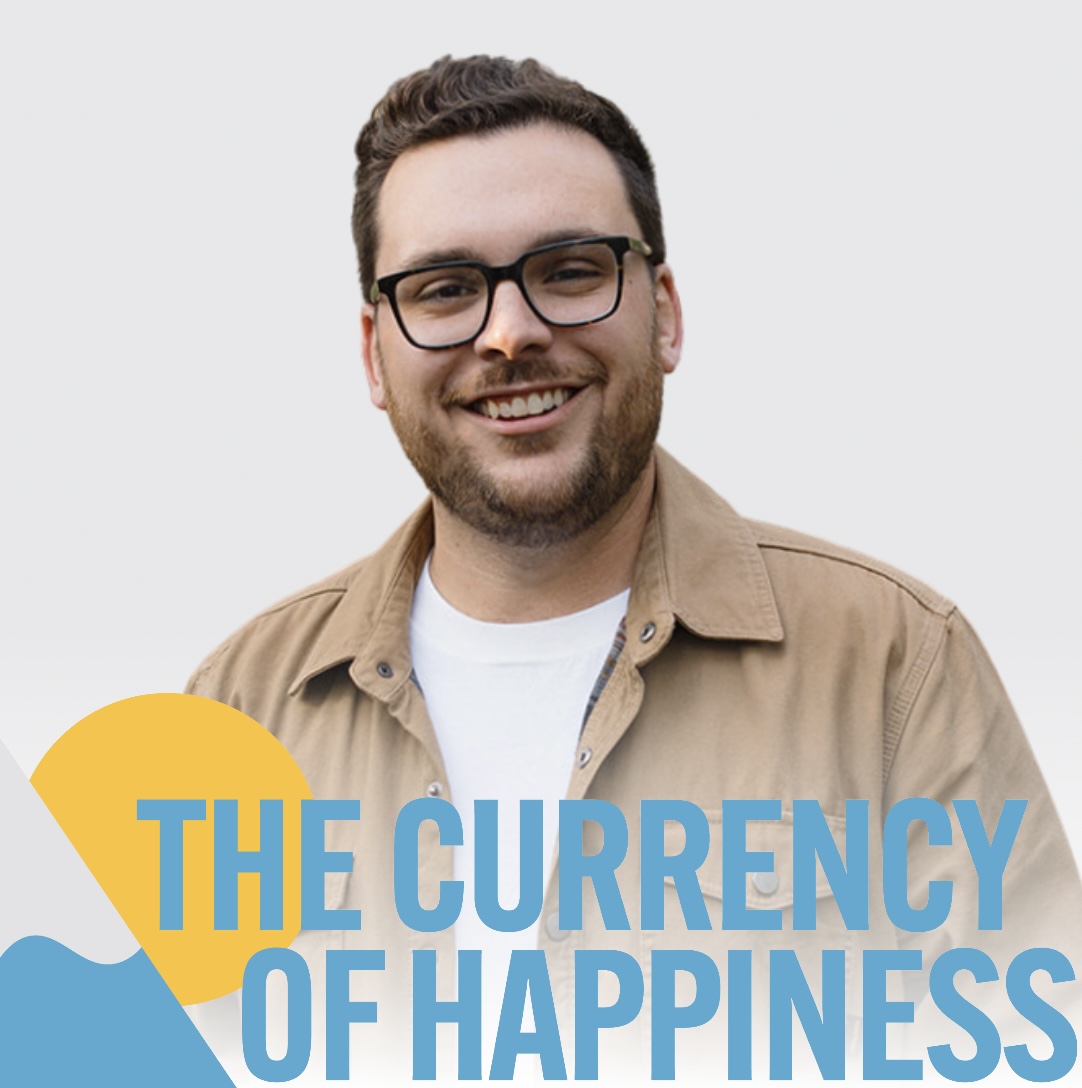
Hey, I'm Andrew!
We crushed $60K of debt in 7 months!
Here is why you shouldn't listen to me:
Had $60,000+ in Debt
Our Relationship Was on the Rocks
I Worked in a Warehouse
Couldn't Afford Steel Toe Boots ... so Found a Size Too Small at a Thrift Store and Had a Numb Toe for 6 Months
But here is why you SHOULD listen to me:
Paid Off $60,000 of Debt in 7 Months
Retired My Wife Before 30 Years Old
Work in Financial Services Industry for 8+ Years
Bought 2 Properties in One Day
Became a 2x Amazon #1 Best Selling Author in 9 Days
Can Now Buy Shoes that Fit
Turn Your Dreams Into Reality
Do you want the FREE framework that I have used to hit every single one of my goals?
Listen to The Currency of Podcast
Launching January 5, 2026



Does this sound familiar?
Are you tired of living paycheque to paycheque?
Do you feel like you're working hard but not getting ahead financially?
Are you tired of chasing success that never quite satisfies?
Do you struggle to understand investing or feel intimidated by it?
Do you avoid looking at your bank account balance?
Do you feel like everyone else has it figured out except you?
Do you dream of being debt-free?
Do you want to feel confident in your financial decisions?
Would you like to leave a financial legacy for your loved ones?
Are you ready for honest conversations about money and meaning?
Do you want real stories, not surface-level success?
Are you ready to treat happiness as something you build, not chase?
Don't worry. I've been there to.
Grab Your Copy of My FREE Goal Setting Framework
A Framework You Can Use Today.
Not Just “Feel Good” Advice.
This isn’t vague motivation.
It’s a simple, step-by-step system I’ve used personally:
✅ Clarity on what matters most
✅ Goals you can actually achieve
✅ Worksheets you will use
✅ Life aligned across money, family, purpose and freedom
Conversations that go deeper than money.

The Currency of Happiness podcast explores life, purpose, leadership, money and meaning through honest conversations with thinkers and doers.
If You Want Clarity On What You Are Building...

Looking For More?
Check out the Blog and More In-Depth Show Notes from the Podcast
Why Trying Harder Won't Fix Your Finances (And What Actually Will)
There's a moment Emily and I still talk about.
We were sitting in our basement suite, the one we'd rented because it was large enough to host all the hypothetical guests we never actually invited over, going through our budget line by line. Rent. Insurance. Debt payments. Groceries. Gas.
When everything was accounted for, we had $5 left.
Not $500. Not $50. Five dollars.
I remember staring at that number and feeling something unexpected. Not shame, not panic, but a kind of quiet clarity. There was no longer any room to pretend. We couldn't try harder. We couldn't hustle our way out of a structure that was designed to keep us exactly where we were.
That was the moment I stopped believing the problem was effort and started understanding it was the system.
The Lie That Keeps People Stuck
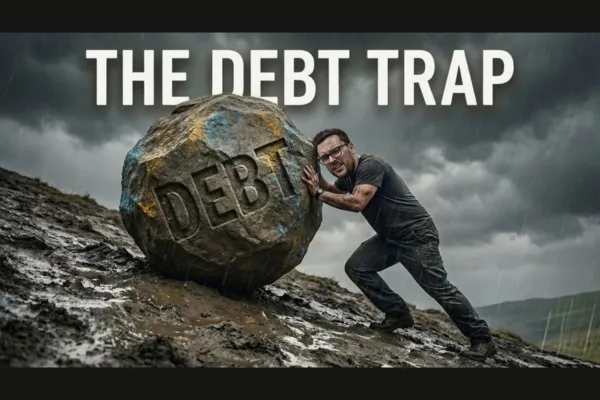
When you're drowning in debt, the advice you'll receive is almost always some version of the same thing: try harder. Cut more. Sacrifice more. Be more disciplined. Just stop spending.
That advice isn't entirely wrong. But it's incomplete in a way that keeps many good, hardworking people stuck for years.
Emily and I weren't reckless. We weren't buying toys and taking vacations while ignoring reality. We were doing what most people do: trying to survive inside a system that makes it easy to drift and very difficult to build.
We had already cut everything. No new clothes. No eating out. Groceries in survival mode. We replaced meat with chickpeas five nights a week because it was the only protein we could consistently afford. People romanticize sacrifice. There is nothing romantic about eating chickpeas every night because you're scared of your own future.
The problem wasn't our effort. The problem was our structure.
What Debt Actually Does to You
Most conversations about debt treat it like a math problem. It isn't. It's a psychological one.
Research on the emotional effects of financial stress has identified a pattern called Debt-Anger Syndrome, where people under chronic financial pressure become angry at creditors, employers, partners, and ultimately themselves. That anger doesn't stay contained to relationships. The physiological effects can contribute to chronic health issues, including migraines and cardiovascular problems.
That described my experience more than I'd like to admit.
More than half of adults report that debt and money concerns have negatively affected their mental health, contributing to anxiety, stress, and depression. A study from the Royal College of Psychiatrists found that half of adults dealing with problem debt are also managing a mental health issue at the same time.
In daily life, this is what it looks like: debt gets into your sleep. It gets into your confidence. It changes how you make decisions. It makes every conversation about money feel loaded. It quietly teaches you that the life you want is unreasonable, and eventually, you stop dreaming. Not because you're lazy, but because survival doesn't leave much room for vision.
Financial stress is also consistently identified as one of the leading causes of marital conflict, appearing alongside infidelity and lack of commitment in national surveys on why marriages end. Emily and I were early in our marriage during this season. I can tell you from the inside that financial instability doesn't just create tension. It creates distance. It makes two people who genuinely love each other feel like they're on opposite teams.
The debt itself wasn't the only problem. It was what the debt was doing underneath the surface.
Why Willpower Isn't the Answer
Willpower is a depleting resource. The more decisions you force yourself to make consciously throughout the day, the worse your decision-making becomes by the end of it.
Princeton researcher Dean Spears has argued that the constant need to make financial trade-offs creates a form of decision fatigue that is itself a major factor in keeping people trapped in financial hardship. When every purchase requires a mental calculation, cognitive resources get used up faster, leaving less capacity for everything else.
This is the part nobody puts on a motivational poster. The reason you ordered takeout on Thursday even though you swore you wouldn't, the reason you made an impulse purchase you regretted the next morning, the reason you keep falling off the budget you set on Monday. It often isn't a character flaw. It's the predictable result of making too many financial decisions manually, in a depleted state, with no structure in place to catch you.
Behavioural economics research shows that automating financial decisions can increase savings rates by up to 35%. A Duke University study found that roughly 40% of our daily actions are habitual rather than deliberate. If you're managing your money entirely through conscious willpower, you're working against your own biology. The answer isn't more discipline. It's a better design.
The Shift That Changed Everything
The real turning point for Emily and me wasn't finding more money. It was stopping the guessing.
The first shift was the simplest and the most uncomfortable: we wrote everything down. Not to judge it, not to shame it, just to see it. You can't lead what you refuse to look at, and most people aren't overspending so much as they are simply unaware of where the money is going.
Once we had clarity, we made one decisive choice about how to attack the debt. One approach, not ten. I've watched too many people fail at paying off debt, not because they chose the wrong method, but because they kept switching methods and never built any momentum. We committed and stayed committed, not because the plan was perfect, but because consistency beats perfection every time.
Then we systematized everything. Bills are on automatic. Savings were transferred the day paycheques came in, before we had a chance to redirect them. A simple structure that removed the daily decisions that had been quietly wearing us down.
Slowly, something shifted. Money stopped feeling like an enemy and became a tool again.
Within seven months, we had paid off over $60,000 of debt.
The Deeper Question
This post was never really about debt.
Debt is a chapter. It's a symptom. The real question underneath it all is whether your money reflects your values, whether your systems reflect your priorities, and whether you're building your life on purpose or just maintaining it by default.
There's a version of life that looks like freedom from the outside. The car, the house, the thing that makes it feel like you're finally moving forward. But debt quietly makes your world smaller without you noticing until the choices are already gone. Systems do the opposite. They give you back your options, your imagination, and your sense of agency.
The shift from "how do we survive this month" to "what are we actually building" isn't a financial shift. It's an identity shift. And it might be the most important one you make.
A Question to Sit With This Week
Where is your money currently leading you?
Not where you hope it's going. Not where you intend it to go someday. Where is it actually leading you right now, based on the systems you currently have in place?
And just as important: is that where you want to go?
No shame. No guilt. Just honesty. Clarity creates power, and systems create freedom. Freedom is what lets you build a life instead of just financing one.
If you know someone who feels buried right now, share this with them. Sometimes the most important thing is knowing that the problem isn't you. It's the structure. And structures can be changed.
Listen to Episode 6 of The Currency of Happiness wherever you get your podcasts. If this post was useful, subscribe so you never miss an episode.
[Listen on Spotify][Listen on Apple Podcasts][Listen on YouTube]